Some Uses of Apostrophes

’Tis Time to Look at Punctuation

By Annette Rey

While using Facebook I became aware of many people attempting to write English when it is not their primary language. Constructing sentences is difficult for them. I have great admiration for these budding authors. They are my inspiration for writing this basic instruction for those who need this kind of help.

Continue reading

What is Punctuation?

A Few Thoughts on a Big Subject

By Annette Rey

Punctuation – what is it? It is the marks on paper or screen that represent what our physical bodies would be doing at the time we would be saying the words verbally. What do I mean by that? Well, for instance, I can write “She sang the song.” Or “She sang the song!” Or “She sang the song.” Or “She sang the song.” Or “She sang the song.” Or “She sang The Song.” Verbally, I would put inflected sounds of my voice on the italicized words. Additionally, I might use hand gestures, grimaces (if the singing was poor), lifted eyebrows, jumping up and down if enthused, and clapping my hands! All of these movements and inflections would punctuate my verbal story to you.

Continue reading

The Search for Words

When You Cannot Remember the Word (Lethologica)

By Annette Rey

When you are writing, it seems inevitable, interruptions occur that waylay your train of thought; the jangling of the telephone, the doorbell rings, a family member talks to you. That’s bad enough.

What about the pauses in your writing when you can’t remember the right word you know should go right in that spot in your sentence? You’re on a roll and your fingers are moving deftly, except for that!

I have two very good tools to help shorten that unwanted pause, and to get your mind back on writing.

Continue reading

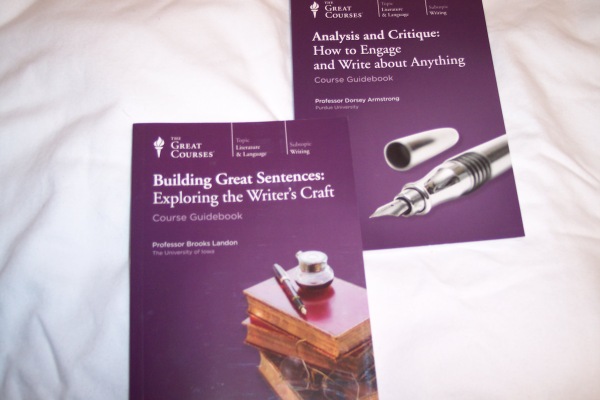
Ten Reasons Why Writers Need The Great Courses on Writing

Include These Lessons in Your Writer’s Library

By Annette Rey

Would you like your writing to flow? If it doesn’t, you could use some help. All of us have developed bad habits over the years where it concerns our writing. Whether you are a new writer or have been at it a long time, you can improve your knowledge of the rules of writing, and how to use the English language.

Take a look with me at what The Great Courses has to offer.

Continue reading

Helpful Reference Books for Writers

Who’s (oops) Whose Grammar Book Is This Anyway? by C. Edward Good

The Big Ten of Grammar by William B. Bradshaw, PhD

Woe is I by Patricia T. O’Conner

The Elements of Style by William Strunk, Jr. and E. B. White

The Oxford Essential Guide to Writing by Thomas S. Kane

Punctuation, Plain and Simple by Edgar C. Alward and Jean A. Alward

Prentice Hall Reference Guide by Muriel Harris

Getting the Words Right, How to Rewrite, Edit, and Revise by Theodore A. Rees Cheney


Four Self-editing Tips

Suggested Steps to Improve Your Work

By Annette Rey

Sometimes writing flows and we think we are inspired. We think we are creating a good piece. And it may be very good. But all writing needs to be reviewed for errors and improvements.

The following four basic steps will help you to self-edit and will tighten up your creation.

One:  Go back to your work a day later to get a fresh perspective. Your subconscious mind has been working and will have improvements in store.

may-16-125Two:  Read your work aloud. Is your voice pausing in places? Perhaps you need to insert a comma. As you read, are you not pausing at a comma point? Review, and the comma may need to be removed. Reading aloud helps you sound for flow, but you should be familiar with punctuation rules. Reading aloud is also necessary in areas of dialogue to identify whether the exchange between characters sounds believable.

Three: Cut unnecessary words from your work. Some writers find this a difficult task as our words are our babies. As you attempt to cut, rearranging words for clarity seems to automatically occur.

Compare:

Original sentence: There are many unnecessary words used in sentences.

Edited sentence:   Many unnecessary words are often used in sentences.

Above is an attempt to shorten a sentence by cutting out the unnecessary words there are. The result is a better sentence of the same length. If you have constructed a good sentence, length is not important as long as the meaning is clear for your reader to understand.

Four: Double-check your work with reference manuals on spelling, grammar, and punctuation. We fall into comfortable habits and speak imprecisely which often translates to errors in our writing.

Please share with me some of the techniques you use to correct your work.


Avoid Those Lovely Adverbs

And Have Fun Doing It

By Annette Rey

Why do professionals advise writers to limit the use of adverbs? Aren’t adverbs descriptive words? Don’t they give a visual to readers of what is going on?

These are good words. Personally, I like them. My lazy side prefers them.

And that is the point. It’s harder to write a sentence that shows the reader what is going on. It takes more thought to find descriptive words. It takes more time. But the results are worth it. You will have more pride in your work and the reader will have a better reading experience.

So let’s look at a few of those adverbs and learn substitutions for them.

Continue reading

Four Ways to Cut Your Writing Expenses

$    Okay. How many writers out there are spending way over their budgets on writing craft books, pretty ink pens, highlighters, folders, notebooks, copy paper and the next gadget being hyped as a just-must-have? Sure, many of these items (and more) can be needed for a writer’s life. But, a beginning writer has more money going out than coming in. How can we spend a bit less, yet gather what we need to produce good work? Some of the following ideas are simple common sense, even mundane suggestions, but worth mentioning.

$   $   $   $   $   $

Continue reading

Benefits of Building a Spiral Notebook Library

In another post I mentioned my spiral notebook library. It is growing and is filled with juicy fodder for my work. The pages are overflowing with my own ideas drawn from reading other authors, instructional excerpts from books on writing, character profiles I am building, chapters of various book projects, small nuggets of grammar, vocabulary – you name it, every aspect of writing.

A review of any of these notebooks opens writing flow like a rushing river and I do not exaggerate. Scraps of thoughts written months ago seem to have germinated in my brain without my realizing it. Revisiting an entry provokes an “Aha!” moment and I’m writing and fleshing out the idea without effort.

Continue reading

Four Points for Struggling Spirits of Struggling Writers

Periodically do you ask yourself, “Will anyone be interested in this that I am writing?”, “Will this sell?”, “Do I have what it takes?”

Most struggling writers have self-doubts, give up from time to time, or throw in their pen completely until their inner muse draws them back, sometimes almost against their will.

But for those times when you are at the crossroads of doubt, or feel simply out of steam, consider following the next four points.

Continue reading